
Do not put NiCd batteries in a NiMH charger unless the charger explicitly supports both chemistries.
NiMH and NiCd cells may share the same 1.2-volt rating and physical size, but safe charging depends on how the charger detects a full battery.
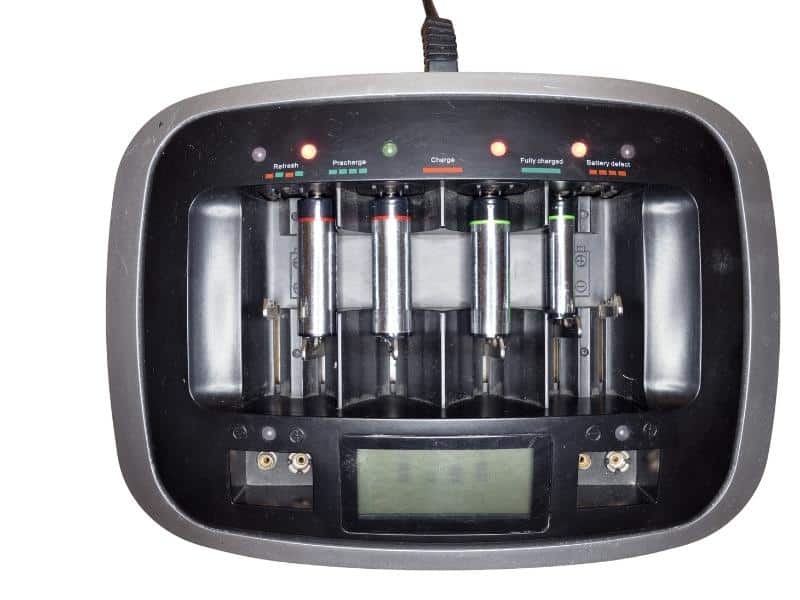
Why the charger chemistry matters
Rechargeable nickel-metal hydride and nickel-cadmium cells accept charge differently. A smart charger watches voltage, temperature, time or a combination of those signals to stop the main charge before the cell overheats.
A charger designed only for NiMH uses an algorithm and current selected for NiMH behavior. It may not terminate correctly with NiCd cells. The result can be excess heat, venting, leakage, reduced battery life or charger damage.
The reverse is also unsafe unless the charger is marked for NiMH. NiMH cells are less tolerant of continuous overcharge, so an old NiCd-only charger can overheat them.
How to tell whether a charger is compatible
Read the label on the charger and its manual. It should name every supported chemistry and cell size. Wording such as “NiMH/NiCd” or separate NiMH and NiCd modes indicates dual-chemistry support.
A label that says only NiMH means NiMH only. Panasonic’s BQ-CC55A instructions, for example, identify the device as a charger for AA and AAA NiMH rechargeable batteries. A slot that physically fits a NiCd cell does not make it compatible.
Also check the number of cells, permitted capacities and whether cells must be charged in pairs. Some chargers control each slot independently, while others charge cells as a pair.
Use a multi-chemistry charger correctly
- Select the NiCd mode when the charger requires manual chemistry selection.
- Do not mix NiMH and NiCd cells in the same charging channel or battery pack.
- Keep cells in a matched set with the same chemistry, size and similar capacity.
- Stop charging if a cell becomes unusually hot, swells, leaks or smells abnormal.
- Never charge alkaline, lithium primary or lithium-ion cells in a nickel-chemistry charger.
Replace damaged cells and recycle them through an approved battery collection service. NiCd batteries contain cadmium and should not go into household waste.
What if the battery type is unclear?
Do not guess. Look for “Ni-MH” or “Ni-Cd” on the wrapper, then find the charger’s model number and instructions. If either label is missing or unreadable, use a known compatible battery and charger instead.
Bottom line: a NiMH charger can charge NiCd batteries only when its manufacturer says it can. Matching voltage and size are not enough.
Sources: Panasonic BQ-CC55A instructions and Energizer NiMH charger handbook.