
Payless Power built its whole business model around one idea: skip the credit check, prepay for power, and keep control of your electric bill day by day. If you’re searching for a payless power minimum balance and daily alerts review, you probably want answers to two questions before signing up: How much money do you need to start, and how strict are the balance alerts that keep your lights on?
This review breaks down the real starting balance requirements, how daily usage alerts work, and what happens if your account balance runs dry. It also looks at where Payless Power rates stand against other Texas electricity providers and what actual customers say about the day-to-day experience.

How Prepaid Funding and Balance Tracking Work
Payless Power runs on a pay-as-you-go system with no credit check. You load money onto your account before using power, and your balance drops daily based on the kilowatt-hours you consume, tracked through your smart meter.
This setup skips the deposit and credit screening that most traditional retail electricity providers require. Instead of billing you at the end of a monthly cycle, Payless Power uses daily billing, deducting charges for usage from two days earlier and sending you an update by text or email.
What Is the Required Starting or Minimum Balance?
Getting started with Payless Power requires a minimum upfront payment, although the exact figure varies by source. Some reports list $40 to start service, while other reviews of Power-To-Go-style prepaid plans mention a $75 minimum to begin.
Once your account is active, there’s no fixed “minimum balance” you must keep on hand. Your balance simply needs to stay above zero to avoid disconnection. Reviewers note that minimum balance charges and rates can feel high to customers used to flat monthly bills, so budgeting for daily use matters more here than it does with a standard fixed-rate plan.
How Daily Usage Alerts and Daily Billing Work
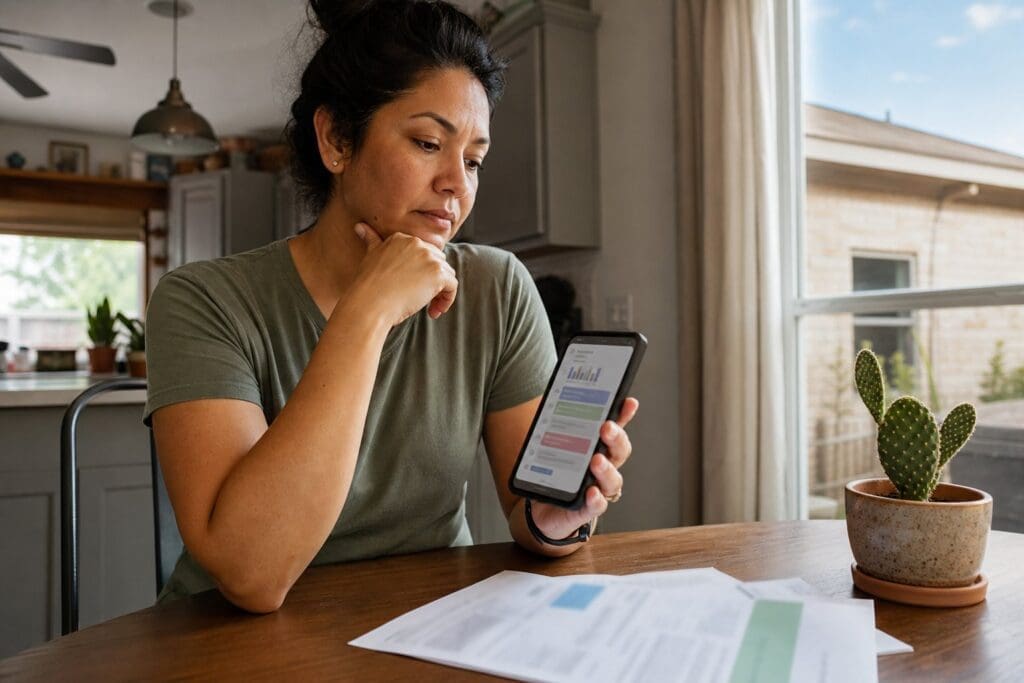
Payless Power sends a text or email each day showing your usage, remaining balance, and how many days of power you have left at your current spending rate, according to a breakdown of the prepaid billing cycle. This daily billing model replaces the single monthly statement you’d receive from a traditional Texas REP.
The alerts pull double duty. They show what you spent yesterday and warn you before your balance hits zero. Customers consistently mention these notifications as one of the service’s most useful features, according to reviews highlighting the daily balance alert system.
Keep in mind that summer air-conditioning use can drain a small balance fast. One review found that loading $25 and running the AC hard could mean running out of balance in two days, so the alerts only help if your phone number and email address stay current in the system.
How to Add Funds and Avoid an Interruption
Reload your balance through the online portal, autopay, or auto-reload before your account hits zero to avoid a shutoff. Payment options include debit or credit cards and MoneyGram for in-person payments, based on details from Payless Power’s own auto-reload guide.
Auto-reload works by setting a dollar threshold, say $20. When your balance drops to that point, a saved card automatically adds funds, commonly $50. It’s a handy way to keep your electricity covered without checking the balance every day.
If your service does get disconnected, expect a reconnection fee to restore power. To manage your account, adjust auto-reload settings, or ask about a reconnection fee, contact Payless Power customer service at 866-963-9353 or through paylesspower.com.
A few habits can reduce the risk of disconnection:
- Raise your auto-reload threshold during summer months
- Turn on both text and email low-balance alerts
- Avoid small, frequent manual payments that won’t last through a hot week
- Choose autopay so reloads happen without you checking the portal daily
Compare electricity rates for your address to see how prepaid plans stack up against fixed-rate options before you commit to a funding schedule.
Is Payless Power Worth the Cost and Service Trade-Off?
Payless Power makes sense if a credit check has blocked you from getting service elsewhere, but its per-kWh electricity rates run higher than many fixed-rate Texas plans. Prepaid rates land around 19+ cents per kWh for standard pay-as-you-go plans, while comparable Power-To-Go plans start near 16.5 cents per kWh.
Independent reviews list Payless Power plans starting around 18.50 cents per kWh, and the company holds a Clear Energy Facts Score of 3.0 out of 5, ranking 28th out of 43 providers reviewed. That puts it in the middle of the pack for pricing transparency and plan quality compared with other retail electricity providers.
How to Check Payless Power Rates in the EFL
Every Texas electricity plan comes with an Electricity Facts Label (EFL), and that document is the only reliable place to confirm your actual rate. The EFL lists the per-kWh charge, TDU delivery charges, and fees separately from the marketing numbers you see online.
Rates advertised for prepaid plans often leave out TDU delivery charges added by your local utility, whether that’s Oncor, CenterPoint Energy, AEP Texas, or TNMP. Reading the EFL before enrolling helps you compare Payless Power rates with other electricity providers listed on Power to Choose, the state’s official shopping site regulated by the Public Utility Commission of Texas (PUCT).
Contract Terms, Cancellation, and Reconnection Costs
Payless Power charges a $49 early termination fee, which reviewers call among the lowest ETFs in the Texas market compared with providers charging $150 to $295 for breaking a contract. That lower fee fits its prepaid model, since customers often use the service short-term while rebuilding credit.
There’s no deposit and no credit check required to start, based on Payless Power’s own FAQ page. Fees mainly appear if your balance runs out and service disconnects, triggering a reconnection fee to restore power.
Here’s how Payless Power compares with a similar prepaid competitor:
| Feature | Payless Power | Direct Energy Power-To-Go |
|---|---|---|
| Starting balance | $40 | $75 |
| Rate | ~19+ cents/kWh | ~16.5 cents/kWh |
| Early termination fee | $49 | $150-$295 |
| Daily balance alerts | Yes | Yes |
| Credit check | No | No |
Source: comparison data on prepaid electricity providers
Where Service Is Available and Who Handles Outages
Payless Power operates across major Texas deregulated markets, including Dallas, Fort Worth, and Houston, based on company service area details. As a retail electric provider, Payless Power sells the electricity, but your local utility, such as Oncor, CenterPoint, AEP Texas, or TNMP, owns the poles, wires, and meters and handles outage repairs.
If your power goes out unexpectedly and your balance isn’t the cause, the outage is a utility issue, not a Payless Power billing problem. Understanding why power sometimes goes out separately from a low-balance disconnection helps you troubleshoot the right problem first.
What Payless Power Reviews Reveal About the Experience
Customer reviews split fairly evenly between praise for convenience and complaints about rates. One review cites 13,700-plus reviews averaging 4.5 stars and calls Payless Power the gold standard for prepaid electricity in Texas, especially for shoppers who can’t pass a credit check.
Other sources report a 4.8 out of 5 rating and a 4.2 out of 5 score from separate review panels. Both cite no credit check and flexible plans as strengths. Complaints tend to focus on customer service wait times during summer billing spikes, according to a review covering real customer feedback, as well as how quickly daily fees drain a small balance during hot months.
Compared with fixed-rate providers like TXU Energy, Payless Power trades lower rates for flexibility and faster approval. If you want predictable monthly billing instead of daily deductions, checking current electricity plans side by side can show whether a traditional contract fits your budget better than prepaid.
Conclusion
Payless Power gives you a way into Texas electricity service without a credit check, backed by a $40 to $75 starting balance and daily usage alerts that flag low funds before disconnection. The trade-off is a higher per-kWh rate than many fixed-rate plans, though the $49 early termination fee stays lower than most competitors.
Reading the Electricity Facts Label before enrolling remains the surest way to confirm your rate and TDU delivery charges. If daily balance tracking sounds like more management than you want, comparing available Texas electricity plans can help you find a fixed-rate option that better matches your household’s usage pattern.