
You can use several generator outlets at once, but you cannot treat each outlet’s faceplate rating as extra generator capacity. Every connected load shares the generator’s continuous output, and each receptacle and breaker has its own limit.
The safe test is simple: stay below the generator’s running-watt limit, the individual outlet limit and any 120-volt leg limit while allowing for the largest appliance starting surge.
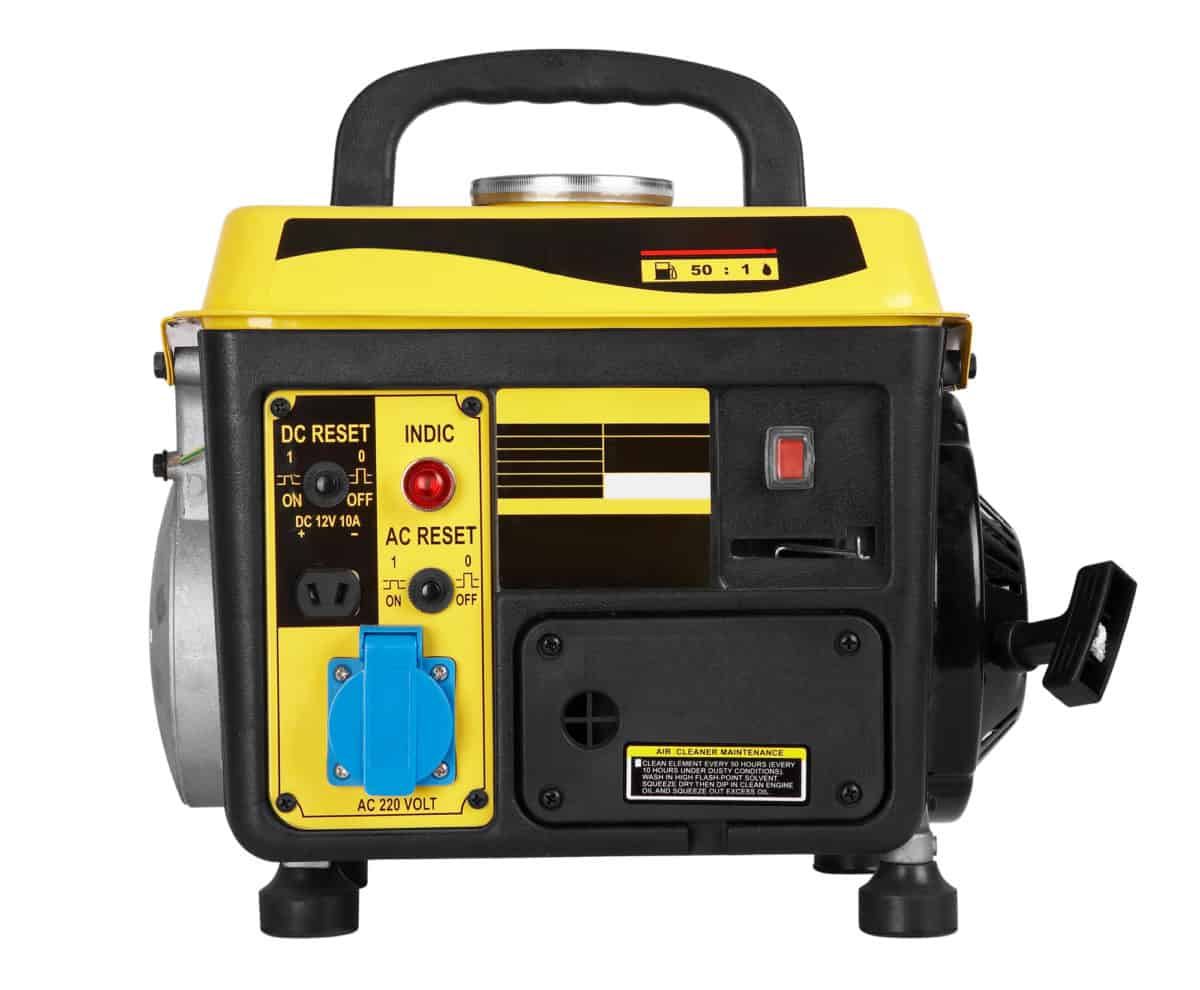
Three Limits Apply at the Same Time
- Total generator output: the combined load across all outlets must stay within the continuous or running rating. Starting watts are available only briefly.
- Individual receptacle and breaker: a 120 V, 20 A outlet is limited to 2,400 W in theory and may have a lower usable limit under the generator’s manual or breaker arrangement.
- Circuit or leg balance: on a 120/240 V generator, too much 120 V load on one leg can trip protection or overload part of the alternator even when total watts appear acceptable.
The plug shape does not guarantee the full amperage printed on a matching cord or appliance. Some generators use a standardized 30 A or 50 A receptacle with a lower breaker because the generator itself cannot produce the connector’s theoretical maximum.
Calculate the Combined Load
List the running watts of every connected appliance. Then add the extra starting watts of the single motor load most likely to start while those appliances are running.
Required capacity = total running watts + largest additional starting demand
Example: lights at 200 W, a refrigerator at 250 W and a microwave drawing 1,500 W create a 1,950 W running load. If the refrigerator needs 1,200 W total while starting, its additional surge is 950 W. The planning requirement becomes about 2,900 W.
Use measured or label input values where possible. Marketing wattage, motor horsepower and microwave cooking output are not reliable electrical-input figures.
Using Different Outlet Types
Duplex receptacles, twist-lock outlets, RV outlets, DC sockets and USB ports can have different voltage, current and protection. Follow the control-panel labels and owner’s manual for each one.
- Do not use adapter chains to turn one receptacle into more capacity.
- Do not exceed the rating of an extension cord, plug, adapter or distribution box.
- Do not combine two generator outlets unless the manufacturer provides an approved parallel or combining system.
- Reset a tripped breaker only after removing load and finding the cause.
- Test GFCI protection as the manual specifies and stop using damaged receptacles.
Safe Ways to Distribute Generator Power
For a few standalone appliances, use individual heavy-duty, outdoor-rated extension cords that are long and thick enough for the load. Keep plugs dry and fully seated, and protect cords from traffic, sharp edges and closed doors.
For home circuits, use an approved inlet and transfer switch or interlock installed according to local rules by a qualified electrician. Never connect a generator to a household receptacle. Backfeeding can energize utility lines and kill workers or damage equipment.
A listed generator distribution box may be appropriate on a jobsite, but its total and branch ratings still apply. Household power strips are not a substitute for outdoor distribution equipment.
Common Generator Outlet Questions
Can every outlet be occupied?
Possibly, if each connected load is small and all generator, circuit, receptacle, cord and balance limits are respected. Occupied outlets are not the same as fully loaded outlets.
Why does one breaker trip below the generator’s rated watts?
The individual receptacle, branch breaker or one 120 V leg may be overloaded even though total generator output is below its headline rating.
Can I use USB and AC outlets together?
Usually, but check the manual. USB output may share internal capacity or have separate electronic limits, and it does not increase the generator’s total rating.
Sources: Generac portable-generator power-limit guidance; Honda generator operating and receptacle guidance; Generac portable-generator safety guidance.