
The best inverter battery is not the one with the biggest amp-hour label. It is the battery bank that can supply the inverter’s continuous and surge current, deliver the required runtime and stay within its safe depth of discharge.
For most new systems, a properly managed lithium iron phosphate battery offers high usable capacity and low maintenance. AGM or flooded lead-acid can still make sense for lower upfront cost, cold-weather charging or an existing compatible system.
Which Battery Type Works Best With an Inverter?
Lithium iron phosphate
LiFePO4 batteries provide more usable energy from a given nameplate capacity than lead-acid batteries and maintain voltage well under load. They also require no watering. The tradeoffs are higher purchase cost and the need for a battery management system that can handle the inverter’s peak current.
Check the permitted charging temperature. Many lithium batteries must not be charged below freezing unless they have low-temperature protection or an approved heating system.
AGM lead-acid
AGM batteries are sealed, widely supported and can deliver high current. They are heavier and provide less usable capacity for the same nameplate watt-hours than lithium, especially when long service life is the goal.
Flooded lead-acid
Flooded deep-cycle batteries can offer low upfront cost and straightforward servicing. They need ventilation, periodic water checks, corrosion control and an installation designed for acid and gas hazards.
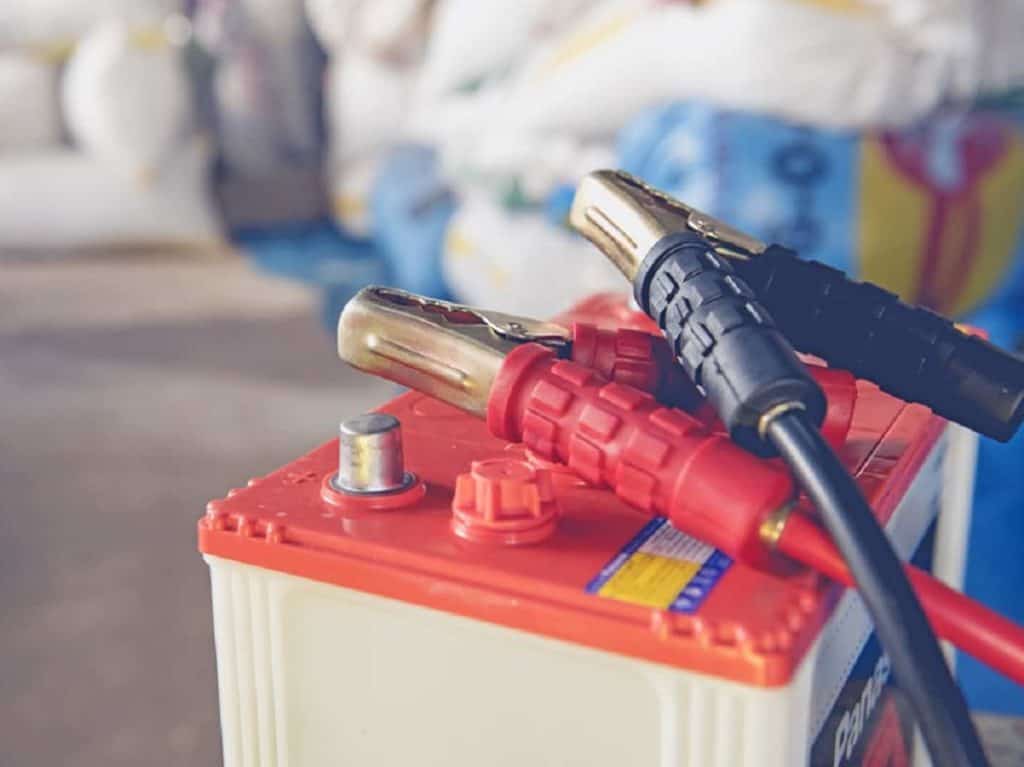
Do not use a starter battery as a routine deep-cycle inverter battery. A car battery is designed for short, high-current engine starts, not repeated deep discharges.
How to Size an Inverter Battery Bank
Start with energy, not amp-hours:
Required nominal battery watt-hours = load watts × runtime hours ÷ inverter efficiency ÷ usable battery fraction
For example, a 500W load for four hours requires 2,000Wh of AC energy. At 90% inverter efficiency and 80% usable battery capacity, the bank needs about 2,778Wh of nominal capacity. At 24V, that is roughly 116Ah before allowing for cold temperature, battery aging or future loads.
This calculation covers runtime, but the battery must also supply the current:
Approximate DC current = AC load watts ÷ battery voltage ÷ inverter efficiency
A 2,000W load on a 12V system at 90% efficiency draws about 185A. The battery, BMS, cables, lugs, busbars, fuse and disconnect must all support that current and any starting surge. Higher-voltage banks reduce current for the same power.
Use the battery manufacturer’s usable-capacity and discharge-rate data. Lead-acid capacity can fall at high discharge rates, and a lithium BMS may disconnect if the inverter surge exceeds its limit.
Match the Battery to the Inverter and Charger
- Voltage: A 12V inverter needs a 12V nominal bank, a 24V inverter needs 24V and a 48V inverter needs 48V.
- Continuous current: The bank and BMS must exceed the inverter’s maximum continuous DC demand.
- Surge current: Allow for motors, compressors and other loads with high starting demand.
- Charge profile: Set bulk, absorption, float and low-voltage limits to the battery maker’s specification.
- Series and parallel rules: Use only combinations the battery manufacturer permits, with matched batteries and balanced cabling.
- Communications: Some lithium systems require approved CAN or data integration with the inverter-charger.
Do not assume two batteries can be mixed because their nominal voltage matches. Different ages, capacities, chemistries or states of charge can create imbalance and unreliable operation.
Cabling, Fusing and Installation
High-power inverters draw substantial DC current. Follow the inverter manual for minimum battery capacity, cable cross-section, fuse rating and maximum cable length. Keep DC runs short and use correctly crimped lugs.
Install a DC-rated fuse or breaker close to the positive battery source as specified by the manufacturer. The fuse must protect the cable and have an interrupt rating suitable for the battery’s available fault current.
Provide the required ventilation and clearances, secure batteries against movement and protect exposed terminals. Use a qualified installer for permanently wired, high-current or code-regulated systems.
Inverter Battery Buying Checklist
- List each load’s running watts and starting watts.
- Choose the required runtime and calculate nominal watt-hours.
- Confirm the battery’s usable energy at the expected discharge rate and temperature.
- Confirm continuous and peak discharge limits, including the BMS limits.
- Match system voltage and charger settings.
- Price the complete system, including cables, protection, enclosure, monitoring and installation.
- Compare warranty terms by allowed use, cycles or energy throughput, not years alone.
Bottom line: Size the battery bank for both energy and current, then follow the inverter and battery manuals for every connection and setting.
Reference: Victron Energy inverter installation guidance.